Seeing NSVD on a pregnancy record, hospital discharge summary, or medical note can be confusing if you’re not familiar with medical abbreviations. Fortunately, the meaning is usually straightforward.
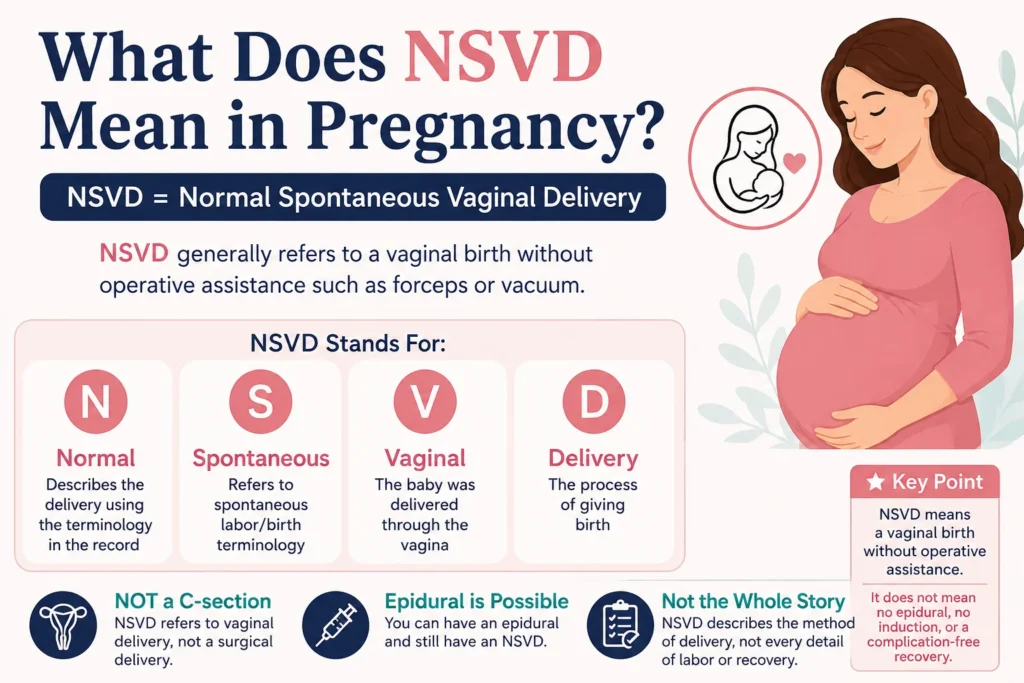
NSVD medical abbreviation most commonly stands for Normal Spontaneous Vaginal Delivery. In general, it refers to a vaginal birth without operative assistance from instruments such as forceps or a vacuum device.
But what exactly does NSVD mean? Does it mean you had no epidural? Does it mean labor was not induced? Is NSVD the same as a vaginal birth or SVD?
This guide explains what NSVD means in pregnancy, what it means on a medical record, how it differs from other types of delivery, and what the abbreviation does—and does not—tell you about childbirth.
Quick answer: NSVD usually means Normal Spontaneous Vaginal Delivery, referring to a vaginal birth without operative assistance such as forceps or vacuum extraction.
What Does the NSVD Medical Abbreviation Mean?
The NSVD medical abbreviation is made up of four letters:
LetterWordMeaningNNormalDescribes the delivery using the terminology in the recordSSpontaneousRefers to spontaneous labor/birth terminology, depending on the documentationVVaginalThe baby was delivered through the vaginaDDeliveryThe process of giving birth
Together, NSVD stands for Normal Spontaneous Vaginal Delivery.
The abbreviation is primarily associated with obstetrics, pregnancy, labor, childbirth, delivery records, and maternity documentation.
However, medical terminology is not always used identically in every hospital, country, or medical-record system. If you’re looking at your own medical record, the surrounding information is important.
What Does NSVD Mean in Simple English?
If your medical record says:
Delivery: NSVD
it generally means:
The baby was delivered vaginally without forceps or vacuum assistance.
In other words, the abbreviation is describing the method of delivery.
Is NSVD the Same as a C-Section?
No.
A C-section, also called a cesarean birth, involves delivering the baby through surgical incisions in the abdomen and uterus. NSVD refers to vaginal delivery.
Delivery termBasic meaningNSVDVaginal birth without operative instrumentsSVDSpontaneous vaginal deliveryAssisted vaginal deliveryVaginal birth using forceps or vacuumC-sectionSurgical delivery through the abdomen and uterus
The safest method of delivery depends on the individual pregnancy, maternal health, fetal condition, and clinical circumstances.
What Does NSVD Mean in Pregnancy?
The NSVD meaning in pregnancy is most often related to the way a baby was delivered.
You may encounter NSVD in:
- Prenatal or obstetric records
- Labor and delivery notes
- Hospital discharge summaries
- Previous pregnancy histories
- Postpartum documentation
- Medical histories
- Birth records
You might see phrases such as:
- “Delivered via NSVD.”
- “History of NSVD.”
- “Previous NSVD.”
- “Term pregnancy, NSVD.”
- “NSVD of a male infant.”
- “NSVD at 39 weeks.”
These phrases generally describe how the baby was delivered, rather than providing a complete history of the pregnancy or labor.
Example of NSVD on a Medical Record
Imagine a discharge summary says:
“Patient delivered a healthy infant via NSVD.”
In everyday language, this generally means:
“The patient gave birth vaginally without operative assistance.”
The abbreviation itself does not provide every detail about the labor or delivery.
What Information Does NSVD Tell You?
NSVD primarily communicates the mode of delivery.
It does not necessarily tell you:
- How long labor lasted
- How painful labor was
- Whether an epidural was used
- Whether labor was induced
- Whether medications were administered
- Whether the pregnancy had complications
- The baby’s exact birth weight
- Whether a tear or episiotomy occurred
- How difficult the delivery was
- What happened during the postpartum period
Those details are normally recorded separately.
What Does “Spontaneous” Mean in NSVD?
The word “spontaneous” can sometimes cause confusion.
In everyday language, someone may interpret spontaneous as:
“Labor started completely naturally without any medical intervention.”
However, the terminology used in medical documentation can be more specific.
ACOG distinguishes spontaneous labor from induced labor. Spontaneous labor refers to labor that begins without pharmacological or mechanical intervention, while induction uses medications or mechanical methods to initiate labor.
Therefore, it is important to look at the complete medical record rather than interpreting one abbreviation by itself.
Does NSVD Mean Labor Was Not Induced?
Not necessarily in every medical documentation context.
Labor induction and the eventual method of delivery can be documented as separate aspects of care.
For example, a patient may have labor induced and ultimately have a vaginal delivery without forceps or vacuum assistance. The record may document both the induction of labor and the eventual vaginal delivery.
For this reason, you should not automatically assume:
“NSVD means absolutely no medical intervention occurred.”
The exact terminology used by the healthcare provider and medical-record system matters.
Does NSVD Mean No Epidural?
No.
Having an epidural does not automatically turn a vaginal delivery into an assisted vaginal delivery.
An epidural is a form of pain relief used during labor. The distinction between an unassisted vaginal birth and an assisted vaginal birth is particularly related to whether instruments such as forceps or a vacuum device were used to assist with delivery.
Therefore, a person can receive pain medication or an epidural and still have a vaginal birth without operative assistance.
NSVD Does Not Automatically Mean:
- No epidural
- No pain medication
- No IV fluids
- No fetal monitoring
- No medical care
- No induction
- No other interventions during labor
NSVD primarily describes the delivery method.
NSVD vs. SVD: What’s the Difference?
SVD commonly stands for Spontaneous Vaginal Delivery, while NSVD stands for Normal Spontaneous Vaginal Delivery.
The main difference is the inclusion of the word “Normal.”
However, medical abbreviations can be used differently between healthcare settings. If you’re interpreting your own medical record, the surrounding documentation is more useful than trying to determine the exact meaning from the abbreviation alone.
In many contexts, both terms are used to describe a vaginal birth without operative assistance.
NSVD vs. Assisted Vaginal Delivery
An assisted vaginal delivery occurs when an instrument is used to help deliver the baby through the birth canal.
The two commonly recognized types are:
- Forceps-assisted delivery
- Vacuum-assisted delivery
Example 1: Unassisted Vaginal Birth
Labor progresses and the baby is delivered vaginally without forceps or vacuum assistance.
This may be documented as a spontaneous vaginal birth or NSVD, depending on the terminology used by the healthcare provider.
Example 2: Vacuum-Assisted Birth
The baby is delivered vaginally with the assistance of a vacuum device.
This is generally classified as an assisted vaginal delivery, rather than an unassisted spontaneous vaginal birth.
Example 3: Forceps-Assisted Birth
Forceps are used to assist with delivery.
This is also considered an assisted vaginal delivery.
NSVD vs. C-Section
NSVD and C-section describe two different methods of delivery.
NSVD refers to vaginal delivery, while a C-section is a surgical method of delivering a baby through incisions in the abdomen and uterus.
TermWhat happened?NSVDVaginal birth without operative assistanceSVDSpontaneous vaginal deliveryVacuum-assisted deliveryVaginal birth using vacuum assistanceForceps-assisted deliveryVaginal birth using forcepsC-sectionSurgical delivery through the abdomen and uterusVBACVaginal birth after a previous cesarean
The purpose of these terms is to describe the method of delivery. One method should not automatically be considered “better” than another because the safest approach depends on the individual clinical situation.
Does NSVD Mean a Natural Birth?
Not necessarily in the way people commonly use the phrase “natural birth.”
Some people use “natural birth” to mean vaginal birth without pain medication, while others use it simply to mean vaginal delivery.
NSVD primarily describes the route and general method of delivery. It does not necessarily tell you whether:
- An epidural was used
- Other pain medication was used
- Labor was induced
- IV medication was administered
- Fetal monitoring was performed
- Other medical care was provided
Therefore, NSVD and “natural birth” should not automatically be treated as identical terms.
Why Is the NSVD Medical Abbreviation Used?
Medical professionals often use abbreviations to communicate information efficiently.
A medical record can contain information about:
- Prenatal appointments
- Laboratory results
- Medications
- Vital signs
- Pregnancy history
- Labor progression
- Delivery method
- Postpartum recovery
- Newborn information
Writing “Normal Spontaneous Vaginal Delivery” repeatedly takes considerably more space than using NSVD.
Why Healthcare Professionals Use NSVD
The abbreviation can:
- Save time
- Reduce repetitive writing
- Make documentation more concise
- Communicate delivery history quickly
- Help clinicians review medical records efficiently
The downside is that abbreviations can be confusing for patients.
If you see NSVD in your medical record and don’t understand it, it is completely reasonable to ask:
“I saw NSVD on my medical record. What does it mean in my case?”
Your healthcare provider can interpret the abbreviation in the context of your complete record.
Common Misunderstandings About NSVD
Medical abbreviations can easily be misunderstood, especially when people encounter them without additional context.
1. NSVD Means a Pain-Free Birth
Incorrect.
NSVD describes the method of delivery. It does not tell you how much pain someone experienced.
Pain management during labor can involve different approaches, including medications, epidural anesthesia, breathing techniques, movement, and other supportive measures.
2. NSVD Means No Medical Care Was Used
Incorrect.
A vaginal birth can involve:
- Fetal monitoring
- IV fluids
- Medication
- Pain relief
- An epidural
- Other forms of medical care
The abbreviation primarily describes the type of delivery.
3. “Normal” Means Other Births Are Abnormal
Not necessarily.
The word “normal” is part of the traditional abbreviation, but it should not be interpreted as saying that C-sections or assisted vaginal births are inferior.
A C-section, assisted vaginal birth, or another medically indicated delivery can be the safest and most appropriate option in a particular situation.
4. NSVD Guarantees an Uncomplicated Recovery
No.
A vaginal delivery can still be followed by postpartum concerns such as:
- Perineal pain
- Tearing
- Bleeding
- Infection
- Other postpartum complications
The delivery abbreviation does not provide a complete assessment of someone’s recovery.
5. An NSVD Abbreviation Is a Diagnosis
No.
An abbreviation describing delivery method does not provide a complete diagnosis or medical history.
If NSVD appears alongside other abbreviations, diagnoses, medications, or findings that you don’t understand, ask your healthcare provider for clarification rather than trying to interpret the entire record from a single term.
What Does NSVD Tell You About Your Birth?
If your medical record says NSVD, the main information being communicated is the method of delivery.
It generally indicates that the baby was delivered vaginally without operative assistance such as forceps or vacuum extraction.
However, NSVD alone does not tell you everything that happened during labor.
For example, you would need additional documentation to determine:
- Whether labor began spontaneously
- Whether labor was induced
- Whether an epidural was used
- How long labor lasted
- Whether medication was administered
- Whether there was a tear
- Whether an episiotomy was performed
- The baby’s birth weight
- Whether complications occurred
- What postpartum care was required
This is why medical records contain multiple sections and entries rather than relying on one abbreviation to describe an entire birth.
A Real-Life Example of NSVD in Context
Imagine a patient looking at her hospital discharge paperwork.
Patient: “My discharge paperwork says NSVD. Is that a complication?”
Nurse: “No. In this context, NSVD means normal spontaneous vaginal delivery.”
Patient: “So my baby was born vaginally?”
Nurse: “Yes. The record is describing the method of delivery.”
Patient: “Does that mean I didn’t have an epidural?”
Nurse: “Not necessarily. Your anesthesia and pain-management information would be documented separately.”
This example demonstrates an important point:
NSVD describes the delivery method, not every detail of labor.
NSVD Medical Abbreviation: Quick Comparison
Absolutely. Here is the clean, non-table version you can paste directly into your article:
What Does NSVD Stand For?
NSVD stands for Normal Spontaneous Vaginal Delivery.
What Does NSVD Mean?
NSVD generally refers to a vaginal birth without operative assistance such as forceps or vacuum extraction.
Is NSVD a C-Section?
No. NSVD refers to vaginal delivery, while a C-section is a surgical method of delivering a baby.
Can Someone Have an Epidural and Still Have a Vaginal Birth?
Yes. Having an epidural does not prevent someone from having a vaginal birth.
Does NSVD Tell You Whether Labor Was Induced?
Not necessarily. Labor induction and the eventual method of delivery can be documented separately.
Is Vacuum Delivery Considered NSVD?
Generally, no. A vacuum-assisted birth is typically classified as an assisted vaginal delivery.
Is Forceps Delivery Considered NSVD?
Generally, no. A forceps-assisted birth is typically classified as an assisted vaginal delivery.
Does NSVD Describe the Entire Pregnancy?
No. NSVD primarily describes the method of delivery. It does not provide complete information about the pregnancy or labor.
Does NSVD Guarantee an Uncomplicated Recovery?
No. NSVD describes the delivery method and does not guarantee that there were no complications during delivery or recovery.
FAQs About the NSVD Medical Abbreviation
What does NSVD stand for in medical terms?
The NSVD medical abbreviation most commonly stands for Normal Spontaneous Vaginal Delivery. It is used in obstetric and maternity documentation to describe a vaginal birth without operative assistance such as forceps or vacuum extraction.
What does NSVD mean in pregnancy?
In pregnancy-related medical records, NSVD usually refers to a vaginal delivery. It describes the method of birth rather than the entire pregnancy or labor experience.
What does NSVD mean on a medical record?
When NSVD appears on a medical record, it generally indicates that the delivery was a vaginal birth without operative assistance. The exact interpretation should be considered alongside the rest of the medical documentation.
Is NSVD the same as SVD?
NSVD stands for Normal Spontaneous Vaginal Delivery, while SVD commonly stands for Spontaneous Vaginal Delivery. These terms can be used somewhat differently depending on the healthcare setting.
Is NSVD the same as vaginal birth?
NSVD is a type of vaginal-birth terminology. More specifically, it generally refers to vaginal delivery without operative assistance such as forceps or vacuum extraction.
Does NSVD mean no epidural?
No. NSVD does not automatically mean that no epidural or pain medication was used. Pain management is a separate aspect of labor care.
Does NSVD mean labor was not induced?
Not necessarily. Labor induction and the eventual method of delivery can be documented separately. The complete medical record is needed to determine whether labor was induced.
Is vacuum delivery considered NSVD?
A vacuum-assisted birth is generally classified as an assisted vaginal delivery because a vacuum device is used to assist with delivery.
Is forceps delivery considered NSVD?
Usually, no. A birth involving forceps is generally considered an assisted vaginal delivery rather than an unassisted spontaneous vaginal birth.
Does NSVD mean a natural birth?
Not necessarily. The phrase “natural birth” can mean different things to different people. NSVD primarily describes the method of delivery and does not necessarily indicate whether pain medication, an epidural, or other medical care was used.
Should I be concerned if my medical record says NSVD?
Usually, NSVD is simply documenting the method of delivery, not identifying a problem. If you’re unsure what it means in your particular record, ask your doctor, midwife, nurse, or medical-records department to explain the complete entry.
Final Takeaway
The NSVD medical abbreviation may look complicated at first, but its most common meaning in obstetrics is straightforward:
NSVD = Normal Spontaneous Vaginal Delivery.
In simple terms, it generally describes a vaginal birth without operative assistance from forceps or a vacuum device.
However, NSVD does not automatically tell you whether labor was induced, whether an epidural was used, how long labor lasted, how painful it was, whether medications were given, or whether other medical events occurred.
The key is to distinguish the method of delivery from the many other details that can occur during pregnancy and labor.
If you see NSVD on your medical record, you now know what it generally means. If other abbreviations or medical terms appear alongside it and you are unsure about their meaning, ask your healthcare provider to explain them in the context of your individual record.
Important: This article explains a commonly used medical abbreviation and is for general information only. It is not a diagnosis or a substitute for advice from your healthcare professional.
Read More:
Why Does a Guy Avoid You Suddenly? 11 Possible Reasons Behind His Sudden Distance
Why Does a Guy Distance Himself? 11 Real Reasons Behind His Sudden Pullback
Why Does a Guy Suddenly Stop Talking? 15 Possible Reasons and What His Silence Really Means

Christopher James is a purpose-driven writer focused on helping readers navigate the digital world with clarity and confidence. Inspired by the meaning of his name—one who carries purpose and continuously evolves—he creates practical, actionable content on AI, online earning, and modern success systems. His goal is simple: turn complex ideas into real-world results you can use immediately.